
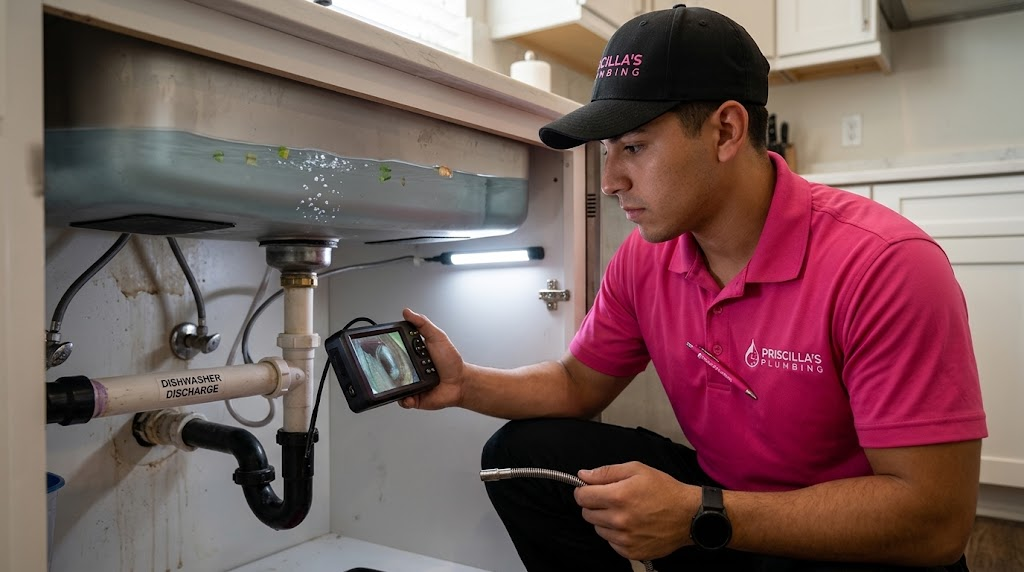
Your dishwasher finishes a cycle, starts draining, and suddenly dirty water rises in your kitchen sink. You did not fill the sink. You did not leave the faucet running. Yet the water keeps coming up.
This is a problem that typically requires a ( drain cleaning) (https://priscillaplumbing.com/services/drain-cleaning )team to clear.
The drain path for the dishwasher and kitchen sink is often the same. When the dishwasher pumps out water, the water moves into this shared line. When grease or food waste, soap, or other substances build up and clog the line, it has less room to flow. The dishwasher continues to run, and water backs up in the sink.
Fortunately, you have some easy steps to start out with. If the backup continues, a plumber will need to inspect the drain line and locate any clog to prevent further flooding.
Why Does the Sink Back Up When the Dishwasher Runs?
First, let's address the reason behind the backup. The main reason is a restricted drain.
Your dishwasher sends a large amount of wastewater into the kitchen drain during the drain cycle. A small restriction might allow the sink to drain normally when you run the faucet. The same restriction might struggle when the dishwasher sends water through the line at a faster rate.
The water then takes the easiest path. In many kitchens, the sink basin becomes the place where the water rises.
A typical drain path looks like this:
Dishwasher → drain hose → air gap or high loop → garbage disposal or drain connection → P-trap → kitchen drain line
A blockage anywhere along this path affects drainage.
5 Common Reasons Your Kitchen Sink Backs Up
You may ask yourself what is causing this blockage in your house. Knowing the problem's primary cause will guide you to the correct repair. These are the 5 most common plumbing problems that result in kitchen sink backups during dishwasher draining into sink cycles.
1. Your P-Trap or Drain Line Is Clogged
The P-trap is located under the sink. It is curved to help retain water and prevent sewer gases from entering the house.
This area is prone to the accumulation of food bits, grease, soap residue, and other waste.
The accumulation eventually causes the opening to become smaller. Your sink might still drain during normal use. The water is flushed out more quickly from the dishwasher, and the limited pipe can't keep up.
If the sink drains slowly when you turn on the faucet, check for a garbage disposal clog in the P-trap or further down the kitchen drain.
2. Your Garbage Disposal Has a Blockage
A lot of dishwashers are attached to the garbage disposal.
A buildup of food debris in the disposal or near the dishwasher inlet can reduce the speed of the disposal. A new disposal also needs special attention. Many disposals come with a factory knockout plug in the dishwasher connection. A plumber removes this plug during installation when a dishwasher connects to the disposal. If the plug stays in place, dishwasher water has nowhere to drain through the disposal.
If your sink started backing up after a new garbage disposal installation, check this connection first.
3. The Air Gap Is Clogged
Look near the back of your sink. You might see a small metal or plastic cylinder beside the faucet. This is an air gap.
The dishwasher air gap helps protect your dishwasher from dirty water flowing back into the appliance. Food particles and grease might collect inside the air gap and block the flow.
A clogged air gap often gives you another clue. Water might spray or spill from the air gap onto the sink or counter while the dishwasher drains.
4. The Dishwasher Drain Hose Is Kinked
The drain hose carries wastewater from the dishwasher to your kitchen drain.
Look under the sink and check the hose.
Watch for:
- Sharp bends
- Pinched sections
- Crushed areas
- Heavy sagging
- Loose connections
- Buildup near the drain connection
A blocked or poorly routed hose slows drainage. Manufacturers also recommend checking the hose routing and looking for a proper high loop or air gap.
5. The High Loop or Drain Setup Has a Problem
Some dishwashers use a high loop in the drain hose. The hose rises high under the counter before connecting to the sink drain or disposal.
The high loop helps reduce the chance of dirty sink water flowing back toward the dishwasher. Some installations use an air gap instead. Your dishwasher model and local plumbing rules determine the correct setup.
If the hose lies low or has changed position after work under the sink, the setup needs a closer look.
Follow These Steps in Order
Now let's address the main question: can the kitchen sink drain clog be solved by cleaning, or do you need a repair? Start with the simple checks. Follow each step one by one to find the block. Stop when the backup stops.
Step 1: Stop the Dishwasher
If dirty water is rising in the sink, stop the dishwasher cycle.
Do not keep running the appliance while the sink is full. You want to prevent more water from entering an already restricted drain.
Step 2: Check the Garbage Disposal
If your dishwasher drains through the disposal, make sure the disposal is clear.
Run cold water and briefly run the disposal if the unit works normally. Keep hands and objects away from the disposal opening.
If the disposal hums, fails to run, or still holds water, stop there and arrange service.
Step 3: Check the Air Gap
If you have an air gap, remove the outer cap and check for visible food or grease buildup in pipes.
Clean the parts according to the manufacturer's instructions. GE recommends removing the cap and clearing material from the air gap and its connecting hose.
Step 4: Check the Drain Hose
Look under the sink.
Make sure the dishwasher hose has no sharp kink or crushed section. Also check whether the hose forms the required high loop for your installation.
Step 5: Check the Sink Drain
Run the kitchen faucet.
Watch how fast the water leaves the sink.
If the sink drains slowly, the blockage likely sits in the P-trap or farther down the shared drain line. If the sink drains well but backs up only when the dishwasher runs, the problem might sit closer to the dishwasher connection, disposal, air gap, or drain hose.
When Should You Call a Plumber?
A simple blockage often needs basic cleaning. A deeper clog needs a different approach.
Call a professional if:
- The sink backs up every time the dishwasher runs.
- The sink drains slowly even when the dishwasher is off.
- Water comes out of the air gap.
- The garbage disposal does not drain properly.
- The drain hose looks damaged.
- You recently replaced the disposal, and the problem started afterward.
- You cleaned the easy-to-reach parts, and the backup continues.
- More than one kitchen drain backs up.
- Dirty water keeps returning to the sink.
A repeated backup often means the restriction sits farther inside the drain line. A plumber has the tools to locate and clear the blockage without guessing.
Your Sink Is Giving You a Clue
When your kitchen sink backs up only when the dishwasher runs, the dishwasher often is not the main problem. A restriction in the shared drain path is a common cause. If the problem persists, contact the drain cleaning Services (https://priscillaplumbing.com/services/drain-cleaning ) team before the next time the dishwasher runs and leaves a dirty sink.
At (Priscilla Plumbing) (https://priscillaplumbing.com/ ), we use expert tools to clear deep line blockages and fix dishwasher drain connections fast. We approach every service call with clean, honest work and clear upfront pricing. We inspect your disposal, clean deep drain lines, adjust your drain hose, and test your system before we finish.
Call us today or visit us online to book your drain line cleaning or repair service.
FAQ
Do you continue to run the dishwasher when the sink backs up?
No, the cycle of the dishwasher should be stopped immediately. If you continue to go around the cycle, you'll keep filling your sink with water, and overflowing dirty water will be left on your sink and floor.
Why does water accumulate at the bottom of a dishwasher?
The trapped water in your dishwasher is caused by a clog in the common drain line. If this occurs, inspect the garbage disposal and air gap at the sink for debris.
Do chemical drain cleaners fix this problem?
The chemicals usually don't work on this kind of clog and can even corrode pipes over time. A drain snake or having a professional plumber come in is a much safer and more effective solution.
How often should you clean your garbage disposal?
Clean your garbage disposal once a week by using a stiff brush and running cold water through it, removing food debris from inside.